
- Home
- About Us
- Courses
- 10 Best Reasons to Join Our Pro Digital Marketing Course – Career Guide 2025
- Digital Marketing for Working Professionals – Upgrade Your Skills Without Leaving Your Job
- Offline Digital Marketing Classes with Hands-On Training and Career Growth
- Online Digital Marketing Course – Master SEO, Social Media & Ads with Live Training
- Weekend Digital Marketing Batch – Start Your Career Without Weekday Hassle
- Basic Digital Marketing for Beginners – Learn the Essentials Step-by-Step
- Modules
- Tools
- Certifications
- Career Track
- Blogs
- Contact Us
What Is Schema Markup? A Complete Beginner to Advanced Guide

What Is Schema Markup? A Complete Beginner to Advanced Guide
If you want your website to stand out on Google, simply publishing good content is no longer enough. Search engines need clarity, context, and structure to understand what your content is really about. This is where schema markup plays a crucial role. Schema markup helps search engines interpret your website data more accurately and display enhanced results such as rich snippets, FAQs, ratings, and breadcrumbs.
Many websites still ignore schema markup, which creates a strong opportunity for businesses, bloggers, and marketers to gain a competitive edge. Whether you run a blog, service website, or course platform like Code with TLS, understanding schema markup can significantly improve your visibility and click-through rate.
In this guide, you will learn what schema markup is, how it works, its benefits, types, implementation steps, and best practices, all explained in simple and practical language for both Indian and global audiences.
What Is Schema Markup?
Schema markup is a type of structured data that you add to your website’s code to help search engines understand your content accurately. It provides clear context about what each page represents, making it easier for search engines to process and display your information correctly.
Rather than relying on assumptions, search engines can read specific signals that explain the purpose of your content. For example, schema markup can indicate whether a page is a blog article, a FAQ section, an online course, a product listing, an event, or a business profile.
This structured approach allows search engines to present your content in more informative ways, such as rich snippets, enhanced listings, and knowledge panels. Schema markup is built using the standardized vocabulary developed by Schema.org, which is officially supported by major search engines including Google, Bing, and Yahoo. As a result, your website content becomes more visible, clearer, and more meaningful in search results.
Why Schema Markup Is Important for SEO
Schema markup plays a crucial role in modern SEO by improving how search engines interpret and present your content. While it does not act as a direct ranking factor, it significantly enhances the way your website appears on search engine results pages. A clearer and more detailed presentation naturally attracts more user attention and drives better engagement.
By providing structured context, schema markup helps search engines match your content more accurately with user intent. This leads to improved visibility, higher trust, and stronger organic performance over time. Websites that implement schema markup often stand out visually, even when competing with higher-ranking pages.
Some of the key SEO advantages of schema markup include increased click-through rates, improved search result appearance, more accurate indexing, and eligibility for rich features such as FAQs and enhanced listings. These benefits work together to strengthen overall search performance without relying on aggressive optimization techniques.
If you are searching for quality training, explore our detailed guide on the top digital marketing course to choose the right program.
How Schema Markup Works
Schema markup functions by embedding structured data into a webpage’s code to clearly define the meaning and purpose of its content. Instead of relying on interpretation, search engines receive direct signals about what the page contains and how it should be categorized.
For instance, schema markup can communicate essential information such as the author of an article, the publication date, the topics covered, and the organization or business behind the content. This added clarity allows search engines to process and classify webpages more efficiently.
Once this structured information is understood, search engines may enhance search listings by displaying rich elements like star ratings, FAQ sections, breadcrumb navigation, or knowledge panels. These enriched results make content more informative and visually appealing, helping users make quicker and more confident decisions.
Why Should You Implement Schema Markup?
Schema markup gives your website a clear advantage in modern search. When structured data is implemented correctly, search engines can display your content as rich results enhanced search listings that include elements like FAQs, ratings, prices, breadcrumbs, and other visual details. These enhanced listings attract more attention than standard blue links, increasing your chances of securing prominent positions on search engine results pages.
Beyond traditional search, schema markup plays a growing role in how AI-driven systems interpret content. Generative AI tools rely heavily on structured data to understand context, summarize information, and identify credible sources. Websites with well implemented schema are more likely to be referenced or cited in AI-generated responses.
Industry research consistently shows the impact of structured data. Studies indicate that the majority of websites ranking in the top positions on Google use schema markup, yet adoption across the web remains relatively low. This gap presents a significant opportunity for businesses and marketers willing to implement structured data correctly and consistently.
By adding schema markup to your website, you can:
- Remove ambiguity for both search engines and users
- Qualify for rich results such as ratings, pricing, and FAQs
- Improve relevance for targeted search queries
- Help AI systems accurately interpret and summarize your content
- Build a structured content knowledge graph that supports future search technologies
How to Implement Schema Markup
The process of implementing schema markup has become far more accessible in recent years. Improved tools and better documentation mean that even non-technical users can add structured data without advanced coding skills. The exact method depends on your website platform and technical comfort level.
Regardless of your setup, schema markup should be placed inside the section of your webpage. This ensures that search engine crawlers detect the structured data early during page analysis.
Below is a practical roadmap, from simplest to more advanced implementation methods.
Learners planning to upskill for the future should read our complete guide on learn digital marketing in 2026 for updated trends and skills.
Schema Markup for WordPress Websites
WordPress users have the easiest path to schema implementation. Most websites can add structured data without touching code by using dedicated SEO plugins.
Popular plugins such as Rank Math, Yoast SEO, and Schema Pro provide guided setup processes and automatic schema generation. Free versions typically support essential schema types like Article, Organization, and Breadcrumbs. Paid plans unlock advanced features including expanded schema libraries, WooCommerce integration, and site-wide automation.
The most important best practice is consistency. Using multiple schema plugins at the same time can create duplicate or conflicting structured data, which may prevent rich results from appearing. Choose one plugin that aligns with your technical comfort level and manage all schema from that single source.
As a quality check, Google’s Rich Results Test can help you verify which enhancements your current structured data is eligible for.
To gain hands-on industry exposure, check out our digital marketing program with 100% practical training designed for real-world learning.
Manual Schema Markup Implementation
If your website does not support plugins or uses a custom CMS, schema markup can be added manually. This approach offers greater control but may require assistance from a developer or technical team.
Several free tools simplify this process. Platforms like TechnicalSEO, Merkle, and RankRanger allow you to select a schema type, enter your content details, and generate ready-to-use JSON-LD code. Google’s Structured Data Markup Helper offers a visual interface where you tag page elements and automatically generate structured data.
AI tools can also support schema creation. By clearly describing your content, these tools can generate JSON-LD code, explain each property, and help troubleshoot validation errors. This makes manual schema implementation more approachable, even for non developers.
Why JSON-LD Is the Best Schema Format
When choosing a structured data format, JSON-LD is the clear winner. Google officially recommends JSON-LD over older formats such as Microdata and RDFa.
JSON-LD keeps schema separate from your HTML content. It appears as a standalone script that can be added, updated, or removed without affecting page layout or design. This separation makes maintenance easier and reduces the risk of technical errors.
In contrast, Microdata embeds schema attributes directly into HTML tags, increasing the chance of formatting issues during updates. JSON-LD avoids this complexity, making it the safest, cleanest, and most future proof option for schema implementation.
Content creators and marketers can improve productivity by using the best AI tools for content creation explained in detail.
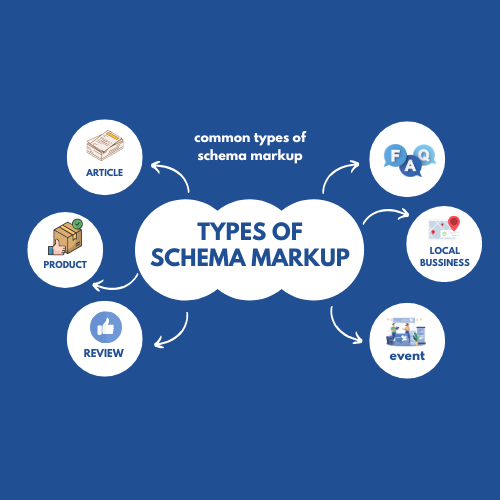
Common Types of Schema Markup
Schema markup comes in many forms, each designed to help search engines understand specific types of content. Using the right schema type ensures that your webpages are interpreted correctly and displayed more prominently in search results. Below are the most commonly used schema markup types and how they support SEO performance.
Article Schema Markup
Article schema markup is designed for blogs, news posts, guides, and educational content published on a website. It helps search engines clearly understand that a page is an article rather than a generic web page. By using article schema, you provide structured information such as the article title, author name, publisher, publication date, and last modified date. This allows search engines to display your content more accurately in search results and, in some cases, feature it in rich snippets or Google Discover.
Article schema is especially important for content-heavy websites, digital marketing blogs, and training platforms. When implemented correctly, it improves indexing efficiency and content credibility. Search engines can also identify the freshness of your content, which is a strong signal for time-sensitive topics. For websites publishing educational or SEO-related content, article schema helps establish authority and trust. It also supports featured snippet eligibility when combined with clear headings and structured formatting. Overall, article schema markup strengthens how your written content is interpreted and presented, making it easier for users to recognize reliable and relevant information.
FAQ Schema Markup
FAQ schema markup is used to structure frequently asked questions and their answers on a webpage. When search engines detect properly implemented FAQ schema, they may display your questions and answers directly in search results. This increases your visibility and allows your listing to occupy more space on the search page, often pushing competitors further down.
FAQ schema is highly effective for informational content, service pages, and educational websites. It helps search engines understand common user queries and how your content addresses them. From a user perspective, it provides instant answers without requiring additional clicks, which builds trust and authority. From an SEO perspective, it improves click through rates and enhances user engagement. FAQ schema is also useful for voice search optimization, as voice assistants rely heavily on structured question and answer data. However, it is important that the FAQs used in schema are visible on the page and provide genuine value. Misuse or misleading answers can result in loss of rich result eligibility.
Breadcrumb Schema Markup
Breadcrumb schema markup helps search engines understand the hierarchical structure of your website. It defines how individual pages are connected and how users navigate from higher level pages to more specific content. When breadcrumb schema is implemented, search engines may replace long URLs in search results with clean breadcrumb trails, making listings more readable and user friendly.
Breadcrumb schema improves both SEO and user experience. It helps search engines crawl your site more efficiently by identifying content relationships. For users, it provides a clear sense of location within the website, reducing confusion and bounce rates. Breadcrumb schema is particularly valuable for large websites, blogs with multiple categories, e-commerce stores, and educational platforms. It also supports mobile usability by simplifying navigation paths. Proper breadcrumb implementation ensures consistency between on page navigation and structured data. When used correctly, breadcrumb schema contributes to better indexing, clearer site architecture, and improved search result appearance without altering the core content.
Organization Schema Markup
Organization schema markup provides structured information about your brand or business to search engines. It includes details such as business name, logo, website URL, contact information, and social media profiles. This schema helps search engines clearly identify your organization and associate your content with a trusted entity.
Organization schema plays a vital role in brand authority and trust building. It supports the creation of knowledge panels and improves brand recognition in search results. For businesses, educational institutes, and digital platforms, this schema ensures consistency across search listings. It also helps prevent brand confusion, especially when similar business names exist. Organization schema is commonly used alongside article, course, or local business schema to strengthen overall SEO signals. When implemented correctly, it reinforces expertise, credibility, and legitimacy, which are essential factors for long term search visibility and user trust.
Local Business Schema Markup
Local business schema markup is used by businesses that serve specific geographic locations. It provides structured details such as business name, address, phone number, operating hours, and service area. This schema is critical for improving visibility in local search results and Google Maps listings.
Local business schema helps search engines match your business with relevant local queries, including “near me” searches. It also improves accuracy in local citations and business profiles. For service providers, training centers, and physical offices, this schema increases the chances of appearing in local packs and map results. Consistency between schema data and Google Business Profile information is essential for best results. When used correctly, local business schema strengthens local SEO performance, improves user trust, and drives higher quality local traffic to your website.
To understand how search behavior is evolving, read our beginner-friendly guide on what is AEO and why it matters in modern SEO.
Schema Markup for eCommerce Sites
Schema markup is especially powerful for eCommerce websites because it helps search engines understand product-related information in detail. When implemented correctly, eCommerce schema allows products to appear in search results with rich features such as prices, ratings, availability, and reviews. These enhanced listings attract high-intent buyers and improve overall conversion rates.
Unlike standard search listings, schema-enabled eCommerce results provide users with essential product details before they even visit the website. This reduces unnecessary clicks and increases the likelihood of qualified traffic that is ready to purchase.
Product Schema
Product schema is the foundation of eCommerce structured data. It communicates critical product information such as product name, description, images, brand, price, availability, and customer ratings. When search engines recognize this data, they may display rich product snippets that stand out visually in search results.
For online stores, product schema helps users compare products faster and builds trust through visible reviews and pricing transparency. Accurate product schema also improves product discoverability for commercial search queries.
Offer Schema
Offer schema works alongside product schema to define pricing and availability details. It includes information such as currency, price validity, stock status, and promotional offers. This schema ensures that search engines always display the most accurate and up-to-date pricing information.
Using offer schema correctly helps prevent mismatched prices between search results and landing pages, which improves user experience and reduces bounce rates.
Review and Rating Schema
Review and rating schema highlight customer feedback directly in search results. This schema displays star ratings, review counts, and aggregate scores, which strongly influence buyer decisions. Products with visible ratings often receive higher click-through rates compared to unrated listings.
For eCommerce SEO, review schema builds credibility and reassures users about product quality before purchase.
Organization and Website Schema
Organization and website schema establish brand identity for eCommerce businesses. They define the company name, logo, website URL, and contact information. This structured data helps search engines associate products with a trusted brand and may support knowledge panel visibility.
For growing eCommerce brands, this schema improves brand recognition and long term authority.
How Schema Improves eCommerce SEO Performance
Schema markup enhances eCommerce SEO by increasing search result visibility, improving click-through rates, and delivering more relevant traffic. Shoppers are more likely to click on results that display prices, ratings, and availability upfront.
Key performance benefits include:
- Higher CTR for product pages
- Improved trust and credibility
- Better indexing of product and category pages
- Increased conversions from search traffic
Best Practices for Schema Markup
To avoid penalties and maximize benefits, follow these best practices:
- Match schema content exactly with on-page content
- Avoid misleading or spammy structured data
- Use only relevant schema types
- Keep schema updated
- Validate schema regularly
Schema markup should support your content, not manipulate search engines.
For advanced optimization strategies, explore our in-depth article on generative engine optimization (GEO) and its impact on AI-driven search engines.
Schema Markup Use Cases
Schema markup is useful across industries:
- Blogs and content websites
- Educational platforms
- Digital marketing agencies
- E-commerce stores
- Local service providers
- Training institutes
For a website like Code with TLS, schema markup improves visibility for courses, articles, and brand authority.
Common Schema Markup Mistakes to Avoid
Many websites fail to benefit from schema due to simple errors:
- Using incorrect schema types
- Adding schema without matching content
- Keyword stuffing inside schema
- Forgetting to update dates
- Ignoring validation errors
Avoiding these mistakes ensures long term SEO stability.
Conclusion: Why You Should Use Schema Markup Now
Schema markup is no longer optional it is a competitive SEO advantage. It helps search engines understand your content, improves how your website appears in search results, and increases user trust before the click happens.
If you want better visibility, higher engagement, and improved search performance, implementing schema markup is a smart and future-proof decision. Websites that adopt structured data early stay ahead in an increasingly competitive digital landscape.
For advanced SEO strategies, structured data implementation, and performance-focused training, Code with TLS helps learners and businesses build search-optimized digital assets that deliver real results.
Call Us
+91 85278 66980
Email Us
Visit Us
2/81-82, Ground Floor, Lalita Park, Gali No - 2, Laxmi Nagar, New Delhi - 110092
Frequently asked question
What is schema markup in HTML?
Schema markup in HTML is structured data added to a webpage’s code that helps search engines understand the content more accurately. It provides additional context about what a page represents, such as an article, product, FAQ, or business. Schema markup is usually added using JSON-LD or microdata within the HTML, allowing search engines to read and interpret page information more clearly.
What is a schema markup generator?
A schema markup generator is a tool that helps create structured data without manual coding. These tools allow users to select a schema type, fill in details, and generate ready-to-use schema code. Schema generators are useful for beginners and businesses that want quick and error-free schema implementation.
What is schema markup in SEO?
Schema markup in SEO refers to the use of structured data to help search engines better understand webpage content. While it does not directly improve rankings, it enhances search appearance by enabling rich results such as FAQs, ratings, and breadcrumbs. This improves click-through rates and overall organic visibility.
What is schema markup in SEO with an example?
Schema markup in SEO helps define content meaning for search engines. For example, adding FAQ schema to a page tells Google that specific questions and answers are present. This allows those FAQs to appear directly in search results, making the listing more informative and increasing user engagement.
What is schema markup in WordPress?
Schema markup in WordPress is added using plugins or manual code insertion. Many SEO plugins automatically generate basic schema, while advanced schema types can be added using custom settings or structured data plugins. WordPress schema helps improve content visibility without requiring deep technical knowledge.
What is a schema markup example?
A schema markup example could include structured data that defines an article’s title, author, publish date, and topic. Another example is product schema, which displays product price, availability, and ratings in search results. These examples help search engines display enhanced listings.
What is a schema markup checker?
A schema markup checker is a tool used to validate structured data implementation. It checks for errors, warnings, and compliance with search engine guidelines. Using a schema checker ensures that your structured data is readable and eligible for rich results.
What are the types of schema markup?
There are many types of schema markup designed for different content needs. Common types include Article, FAQ, Product, Review, Organization, Local Business, Course, Event, and Breadcrumb schema. Choosing the correct schema type helps search engines understand and display content more effectively.
By Best Digital Marketing Course on December 19, 2025